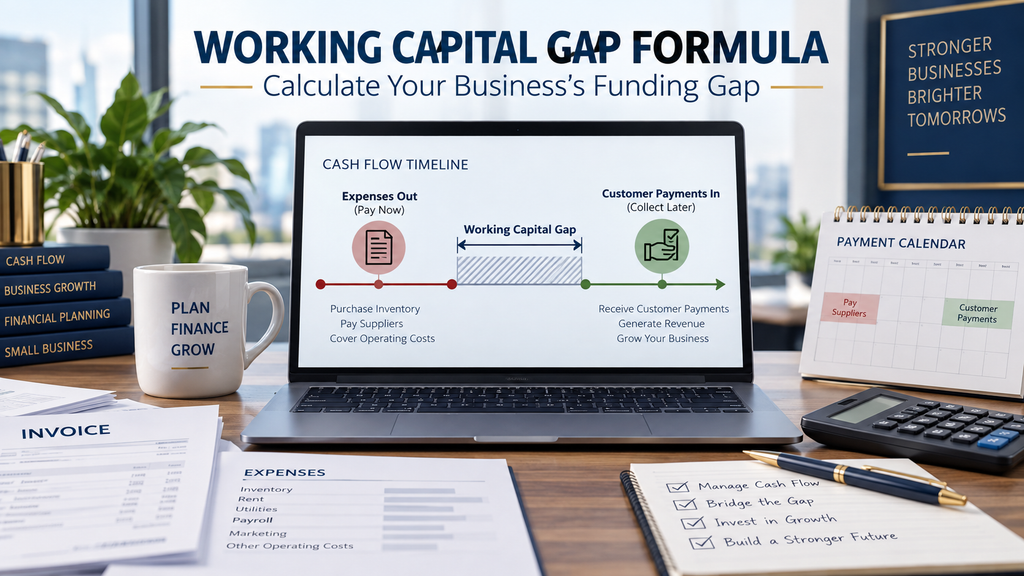
A business can be profitable and still run short of cash. The problem often arises because payroll, inventory, rent, fuel, materials and supplier invoices must be paid before customer revenue reaches the bank account. The working capital gap formula helps estimate how much money may be needed to cover that timing difference.
There is no single accounting figure that captures every business’s real-world funding requirement. However, combining three calculations—net working capital, the cash conversion cycle and a cash-flow forecast—can provide a useful estimate of both the size and duration of a funding gap.
This guide explains how to perform those calculations, shows a worked example and identifies the information that should be reviewed before considering financing.
What Is a Working Capital Gap?
A working capital gap is the period between paying the costs required to operate or complete a sale and receiving the related customer payment. For example, a wholesaler may pay a supplier today, carry inventory for 30 days and then wait another 30 days for a customer invoice to be settled. Cash leaves the business well before it returns.
The size of the gap is affected by:
- How quickly inventory is purchased and sold
- How long customers take to pay invoices
- When suppliers and other expenses must be paid
- Seasonal purchases or temporary increases in demand
- The amount of unrestricted cash already available
For a broader explanation of the underlying causes, see our guide to what creates a working capital gap. The calculations below focus specifically on measuring that gap.
Working Capital Gap Formula: The Quick Estimate
A practical starting point is to estimate the operating expenses that must be covered during the gap and subtract cash that is already available for that purpose.
Estimated funding gap = (Average monthly cash operating expenses × Gap days ÷ 30) − Available cash buffer
If the result is negative, the available cash buffer may be sufficient for the assumptions used. If it is positive, the result estimates the amount that may need to be covered.
Use cash expenses rather than non-cash accounting items. Typical inputs include payroll, inventory, supplier payments, rent, utilities, insurance, fuel and other essential operating costs. Depreciation is generally excluded because it does not represent a current cash payment.
Worked example
Assume a business has:
- Average monthly cash operating expenses of $90,000
- A 45-day gap between paying expenses and collecting revenue
- $35,000 of cash that can safely be used as a buffer
Step 1: Calculate the cash expenses occurring during the gap.
$90,000 × 45 ÷ 30 = $135,000
Step 2: Subtract the available cash buffer.
$135,000 − $35,000 = $100,000 estimated funding gap
Under these assumptions, the business may need approximately $100,000 to cover the timing gap. This is a planning estimate—not an automatic recommendation to borrow that amount. Taxes, debt payments, capital purchases, owner distributions, unexpected expenses and a minimum emergency reserve should be reviewed separately.
Formula 2: Net Working Capital
Net working capital measures short-term balance-sheet liquidity:
Net working capital = Current assets − Current liabilities
Current assets commonly include cash, accounts receivable and inventory expected to be converted into cash within a year. Current liabilities commonly include accounts payable and other obligations due within a year.
Suppose a company has $240,000 in current assets and $185,000 in current liabilities:
$240,000 − $185,000 = $55,000 in net working capital
A positive figure suggests that current assets exceed current liabilities. A negative figure can signal liquidity pressure. However, this calculation alone does not show when cash will actually arrive. A company may have substantial accounts receivable and inventory but very little immediately available cash.
That is why net working capital should not be treated as the same thing as the funding gap. It is a useful balance-sheet measure, while the funding-gap estimate focuses on cash timing.
Formula 3: Cash Conversion Cycle
The cash conversion cycle estimates how many days cash is committed to operations before being recovered from customers:
Cash conversion cycle = Days inventory outstanding + Days sales outstanding − Days payable outstanding
- Days inventory outstanding (DIO): the average number of days inventory is held before being sold.
- Days sales outstanding (DSO): the average number of days required to collect customer invoices.
- Days payable outstanding (DPO): the average number of days the business takes to pay suppliers.
If a business holds inventory for 35 days, collects invoices in 40 days and pays suppliers in 25 days, its estimated cycle is:
35 + 40 − 25 = 50 days
This means cash may remain tied up in the operating cycle for approximately 50 days. A shorter cycle generally reduces pressure on working capital, while a longer cycle generally increases the amount of cash that must be available.
How to Calculate the Three Day-Based Inputs
The following formulas can be used with figures from a consistent accounting period:
Days inventory outstanding
DIO = Average inventory ÷ Cost of goods sold × Number of days in the period
Days sales outstanding
DSO = Average accounts receivable ÷ Credit sales × Number of days in the period
Days payable outstanding
DPO = Average accounts payable ÷ Cost of goods sold × Number of days in the period
Use comparable opening and closing balances to calculate averages, and use the same period for each input. Businesses without inventory can omit DIO. Cash-sale businesses may have very low DSO, although payment-processor settlement times should still be considered.
The Most Reliable Method: Build a 13-Week Cash-Flow Forecast
Formulas provide a helpful estimate, but a weekly forecast can reveal exactly when the lowest cash balance is expected to occur. A 13-week forecast is long enough to expose many payroll, rent, tax, supplier and receivable cycles while remaining practical to update.
- Enter opening cash. Include only cash that is genuinely available for operations.
- List expected weekly inflows. Use realistic collection dates rather than invoice dates.
- List required weekly outflows. Include payroll, inventory, rent, supplier payments, taxes, insurance and debt obligations.
- Calculate each week’s closing balance. The closing balance becomes the following week’s opening balance.
- Identify the lowest projected balance. Compare it with the minimum cash reserve the business intends to maintain.
Forecast funding gap = Required minimum cash reserve − Lowest projected cash balance
For example, if the lowest forecast balance is negative $40,000 and the business wants to preserve a $20,000 minimum reserve, the forecast indicates a potential $60,000 gap.
You can organize these figures using Rock Drive’s free 13-week cash-flow calculator.
What Should Be Included in the Calculation?
A useful estimate should reflect the cash commitments that cannot simply be postponed. Depending on the business, these may include:
- Payroll and payroll taxes
- Inventory and raw materials
- Supplier and subcontractor payments
- Rent, utilities and insurance
- Fuel, freight and delivery costs
- Loan and equipment payments
- Essential repairs and maintenance
- Seasonal purchasing commitments
Avoid assuming that every dollar in the bank is available. Some cash may be needed for taxes, restricted purposes, upcoming debt payments or the company’s emergency reserve.
Common Calculation Mistakes
Using profit instead of cash flow
Profit records revenue and expenses according to accounting rules. It does not necessarily show when money enters or leaves the bank. Use expected cash receipts and payments when calculating the funding gap.
Assuming every invoice will be paid on time
Base collection dates on actual customer behavior. If major customers usually pay in 45 days, a forecast based on 30-day payment terms may understate the gap.
Ignoring growth
Growth can increase a gap because the business may need more inventory, labor or materials before the additional revenue is collected. Use forward-looking expenses rather than relying only on last month’s averages.
Counting unavailable cash
Tax reserves, restricted funds and money already committed to essential payments should not be treated as a general operating buffer.
Borrowing exactly to the formula
The estimate is a planning tool. Financing costs, repayment timing, revenue volatility and a reasonable contingency should be considered before selecting any amount or product.
Ways to Reduce a Working Capital Funding Gap
Before taking on financing, a business may be able to reduce the gap by:
- Sending invoices promptly and following up consistently
- Requesting deposits or milestone payments where appropriate
- Reducing slow-moving inventory
- Negotiating longer supplier terms without damaging relationships
- Matching large purchases more closely to confirmed demand
- Maintaining a rolling weekly cash-flow forecast
- Building a dedicated operating reserve during stronger months
If an unavoidable timing gap remains, businesses can explore working capital financing options. The appropriate structure depends on the amount needed, how quickly the cash is expected to return and whether the need is recurring or one-time.
Frequently Asked Questions
Is the working capital gap the same as negative working capital?
No. Negative working capital means current liabilities exceed current assets on the balance sheet. A cash-timing gap can also affect a company with positive net working capital when receivables or inventory cannot be converted into cash quickly enough.
Can a profitable company have a working capital gap?
Yes. Profitability does not guarantee that cash receipts arrive before payroll, inventory and supplier payments are due.
How often should the calculation be updated?
A growing or seasonal business should review its short-term forecast weekly. The net working capital and cash conversion cycle calculations may also be reviewed monthly or quarterly to identify trends.
How much financing should a business request?
The amount should be based on a realistic forecast, a clearly identified use of funds and an affordable repayment plan. The calculated gap is only one input; financing costs, existing obligations and possible downside scenarios also matter.
Calculate the Gap Before Choosing a Solution
A useful working capital calculation answers two questions: how much cash may be missing, and for how long? Net working capital provides a balance-sheet view, the cash conversion cycle estimates the timing, and a 13-week forecast shows the likely week-by-week cash requirement.
Once those figures are clear, a business can decide whether operational changes may be enough or whether outside financing should be considered.
Explore Your Business Funding Options
Tell us about your business and the working capital need you are trying to manage.
This article is for general educational purposes only and is not financial, legal, tax or accounting advice. Financing is subject to application, underwriting and provider approval. Terms, costs and availability vary.