Merchant Cash Advance Requirements: What Do You Need to Qualify?
Merchant cash advances can have different qualification requirements from traditional business loans.
Instead of focusing primarily on collateral, profitability or a high personal credit score, merchant cash advance providers generally place significant weight on the recent revenue and cash flow of the business.
That does not mean every business with sales will qualify.
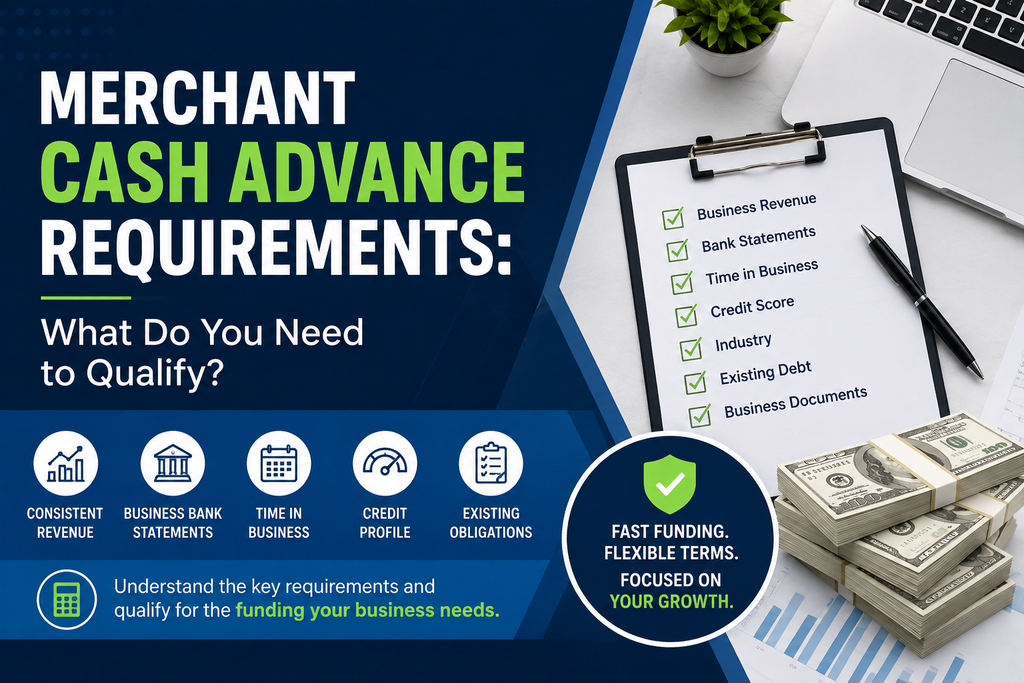
Providers may review your monthly revenue, bank statements, time in business, deposit consistency, existing financial obligations, industry and credit profile before deciding whether to make an offer.
Understanding these merchant cash advance requirements before applying can help you prepare the right documents and identify potential issues in advance.
What Is a Merchant Cash Advance?
A merchant cash advance, commonly called an MCA, is a form of commercial financing in which a provider advances capital to a business in exchange for an agreed amount of its future receivables or revenue.
It is generally structured differently from a conventional business loan.
If you’re unfamiliar with the structure, start with our complete guide to what a merchant cash advance is and how it works.
Qualification also works somewhat differently.
Traditional lenders may place considerable emphasis on credit, profitability, financial statements and collateral. MCA providers commonly place greater emphasis on the business’s recent revenue and cash-flow activity.
Exact requirements vary significantly between providers.
What Are the Typical Merchant Cash Advance Requirements?
There is no universal set of MCA requirements that applies to every provider.
However, providers commonly consider:
- Monthly business revenue
- Consistency of business deposits
- Time in business
- Recent business bank statements
- Average bank balances
- Overdrafts and negative-balance days
- Returned payments
- Existing loans and advances
- Personal and business credit
- Industry
- Business ownership and identity
- Intended use of funds
Meeting one requirement does not guarantee approval. Providers generally evaluate the overall financial position of the business.
1. Consistent Business Revenue
Revenue is one of the most important merchant cash advance qualification factors.
Because the transaction involves future business receivables or revenue, the provider needs evidence that the business is generating sufficient sales to support the proposed arrangement.
Underwriters may examine both the amount and consistency of revenue.
For example, a business generating $50,000 every month may present a different risk profile from a company that generated:
- $90,000 one month
- $18,000 the next
- $55,000 the following month
Even if their average revenue appears similar, the second business has considerably greater volatility.
Providers may therefore look beyond the headline monthly-revenue figure.
Is There a Minimum Monthly Revenue Requirement?
There is no single minimum revenue requirement for all merchant cash advances.
Each provider establishes its own underwriting criteria.
The amount required may also depend on the requested advance, industry, time in business, existing obligations and overall financial profile.
Avoid assuming that reaching a particular monthly-sales number guarantees approval.
If you’re trying to estimate what your business could potentially support, read our guide explaining how much business funding you may qualify for.
2. Recent Business Bank Statements
Recent business bank statements are commonly requested when applying for an MCA.
A provider may request several months of statements to verify revenue and understand how money moves through the business.
Underwriters may review:
- Total monthly deposits
- Number and frequency of deposits
- Average daily balances
- Ending balances
- Overdrafts
- Negative-balance days
- Returned or insufficient-funds transactions
- Existing financing withdrawals
- Unusual transfers
- Significant changes in revenue
Bank statements can therefore tell an underwriter considerably more than simply how much revenue the business generates.
Why Do Negative Balance Days Matter?
Frequent negative balances may indicate that a business is already struggling to meet its existing expenses.
An occasional unusual month does not necessarily determine the outcome of an application, but repeated overdrafts or returned payments can make an application more difficult.
Maintaining healthier balances and avoiding unnecessary overdrafts before applying may help present a clearer financial picture.
3. Time in Business
MCA providers commonly have a minimum time-in-business requirement.
An established operating history gives an underwriter more information about:
- Revenue consistency
- Seasonal changes
- Cash-flow patterns
- Business stability
A newer business has less financial history for the provider to evaluate.
That does not necessarily mean a younger business cannot qualify, but it may have fewer available options.
Minimum operating-history requirements vary by provider, so business owners should not rely on a single universal number.
4. Personal and Business Credit
Can you qualify for a merchant cash advance with bad credit?
Potentially.
Credit can still be part of the underwriting process, but some MCA providers place substantial weight on business revenue and cash flow rather than relying on credit score alone.
Credit may nevertheless influence:
- Whether an offer is available
- The amount offered
- Factor rate or overall cost
- Payment structure
- Additional conditions
- Personal-guarantee requirements
A stronger business profile may sometimes provide options even when the owner’s credit is imperfect.
For a more detailed explanation, read Can You Get Business Funding With Bad Credit?
Approval is never guaranteed solely because a business has strong revenue.
5. Existing Business Debt and Advances
Existing financial obligations are another important consideration.
A provider may review payments associated with:
- Business loans
- Existing merchant cash advances
- Business lines of credit
- Equipment financing
- Revenue-based financing
- Tax-payment arrangements
- Other recurring obligations
Why does this matter?
A company may generate substantial revenue but already have a large portion of its cash flow committed to existing payments.
Consider two businesses that each generate $100,000 per month.
Business A has relatively few existing financial obligations.
Business B has several daily and weekly financing payments.
Even with identical revenue, the two businesses may have very different capacity to take on another obligation.
Obtaining multiple advances at the same time can create significant cash-flow pressure and should be approached particularly carefully.
6. Your Industry
Industry can affect merchant cash advance eligibility.
Providers may evaluate factors such as:
- Revenue volatility
- Seasonality
- Historical performance
- Chargeback risk
- Regulatory considerations
- General industry risk
A restaurant, contractor, retailer and professional-services company may therefore be evaluated differently even if they generate similar revenue.
Some providers also maintain lists of industries they will not fund.
7. Business Ownership and Identification
Providers need to verify both the business and the individuals who own it.
You may therefore be asked for information such as:
- Legal business name
- DBA name, if applicable
- Employer Identification Number (EIN)
- Business address
- Business formation information
- Ownership percentages
- Government-issued identification
- Social Security number or other identifying information where required
- Business bank-account information
Information provided on the application should match official records wherever possible.
Inconsistencies can create delays while the provider completes verification.
What Documents Do You Need for a Merchant Cash Advance?
Documentation varies by provider and transaction.
Commonly requested documents can include:
- Recent business bank statements
- Government-issued identification
- Business formation documents
- Proof of ownership
- Voided business check or bank verification
- Current business lease, when applicable
- Accounts-receivable information
- Card-processing statements
- Details of existing financing
- Tax returns or financial statements in some circumstances
Not every provider will request every document.
Larger transactions or more complex applications may require additional financial information.
Providing complete and accurate documentation from the beginning can help prevent unnecessary underwriting delays.
Do You Need Collateral for a Merchant Cash Advance?
Many merchant cash advances do not require the business to pledge a particular physical asset such as a vehicle, property or piece of equipment as collateral in the same way some secured loans do.
However, that does not mean an MCA agreement contains no security provisions.
Depending on the agreement, there may be:
- A UCC filing
- A personal guarantee
- Restrictions involving the business’s receivables
- Other contractual protections for the provider
Business owners should read these provisions carefully before signing.
Do You Need Good Credit for an MCA?
Not necessarily.
One reason some businesses explore merchant cash advances is that traditional financing may be difficult to obtain when the owner’s credit profile is imperfect.
However, “bad credit accepted” should never be interpreted as “credit doesn’t matter.”
A weaker credit profile can still affect available offers, pricing and terms.
The provider will generally consider credit alongside revenue, bank activity, existing obligations and other underwriting factors.
How Much Can You Qualify For?
There is no responsible way to determine an MCA amount from monthly revenue alone.
Providers can consider:
- Average monthly revenue
- Revenue consistency
- Existing obligations
- Bank balances
- Negative-balance days
- Credit
- Industry
- Time in business
- Requested amount
- Provider-specific underwriting criteria
Two businesses generating exactly the same monthly revenue could therefore receive very different decisions.
Read our complete guide to how much business funding you may qualify for to understand these factors in greater detail.
How Can You Improve Your Chances of Qualifying?
There is no way to guarantee MCA approval, but businesses can take practical steps to present a stronger application.
Keep Business and Personal Finances Separate
Use a dedicated business bank account and ensure business revenue is deposited consistently.
Maintain Healthier Bank Balances
Where possible, reduce frequent overdrafts and negative-balance days.
Avoid Unnecessary New Obligations
Taking additional financing immediately before applying may reduce available cash flow.
Prepare Your Documents
Have recent bank statements, identification and business information readily available.
Check Your Application Carefully
Make sure revenue, ownership information and other details are accurate and consistent with your supporting documentation.
Request an Appropriate Amount
Asking for significantly more capital than the business can realistically support may make the application more difficult.
MCA Requirements vs. Traditional Business Loan Requirements
Merchant cash advances and traditional loans are underwritten differently.
A conventional lender may place greater emphasis on:
- Personal and business credit
- Profitability
- Tax returns
- Debt-service coverage
- Collateral
- Detailed financial statements
MCA providers may place comparatively greater emphasis on:
- Recent revenue
- Deposit consistency
- Business bank statements
- Current cash flow
- Existing obligations
Neither structure is automatically better.
Traditional financing may offer a lower cost when a business qualifies and has sufficient time to complete the process.
An MCA may be considered when a business has consistent revenue, needs capital for a specific commercial purpose and does not meet—or cannot wait for—traditional financing requirements.
You can compare MCAs with other sales-based structures in our Revenue-Based Financing guide.
Qualifying Doesn’t Mean You Should Automatically Accept an MCA
This is an important distinction.
Getting approved does not mean an offer is necessarily suitable for your business.
Before accepting an MCA, review:
- The amount you will actually receive
- The purchased amount or total repayment
- The factor rate
- Any additional fees
- Payment amount
- Payment frequency
- Estimated duration
- Reconciliation provisions, where applicable
- Early-payment provisions
- Personal guarantee or UCC provisions
- Events that constitute default
Then consider the effect of those payments during a slower-than-normal month.
If the payment could interfere with payroll, rent, taxes, inventory or other essential expenses, the financing may place too much pressure on the business.
What If You Don’t Meet the MCA Requirements?
An MCA is only one possible business financing structure.
Depending on your qualifications and intended use of capital, alternatives may include:
- Working capital financing
- Business lines of credit
- Equipment financing
- Term financing
- Invoice-based financing
- Revenue-based financing
Explore the available business financing options before deciding which structure makes sense for your situation.
The best financing product is not necessarily the easiest one to qualify for. Cost, payment structure, purpose and the effect on future cash flow all matter.
Frequently Asked Questions
What are the basic requirements for a merchant cash advance?
Requirements vary by provider, but commonly reviewed factors include business revenue, time in business, recent bank statements, deposit consistency, existing obligations, credit and industry.
How many months of bank statements do I need for an MCA?
Providers commonly request recent business bank statements, but the exact number varies. Additional statements or financial documentation may be requested depending on the application.
Can a new business qualify for a merchant cash advance?
Possibly, but providers typically require some operating history. Requirements vary, and newer businesses may have fewer available options.
Can I qualify for an MCA with bad credit?
Potentially. Some providers place significant weight on revenue and cash flow, although credit can still influence approval, amount, cost and terms.
Do I need collateral?
Many MCAs do not require a specific physical asset as collateral, although agreements may contain personal guarantees, UCC filings or other protections.
Does high revenue guarantee approval?
No. Providers may also review bank balances, existing obligations, credit, deposit consistency, industry, time in business and other underwriting factors.
How quickly can an MCA be approved?
Timing varies by provider, documentation, verification and the complexity of the application. Businesses should be cautious of absolute or guaranteed approval and funding-time claims.
Prepare Before You Apply
Merchant cash advance requirements are generally focused on the financial health and current revenue of the business.
Strong revenue can help, but providers may also consider how consistently that revenue arrives, how the business manages its bank account, its existing financial obligations, credit profile, operating history and industry.
Preparing your documentation and understanding these factors before applying can make the process considerably clearer.
Rock Drive Business Capital helps U.S. business owners explore merchant cash advances and other commercial financing options through independent financing providers.
See what business funding options may be available →
Submitting an application does not guarantee approval or funding. Products, amounts, factor rates, costs, terms and availability vary by provider, applicant and jurisdiction.
Important Disclosure
Rock Drive Business Capital is a commercial financing brokerage, not a bank or direct lender. We help businesses explore potential financing options from independent providers. All applications are subject to underwriting, verification, provider requirements and final approval. Not every applicant will qualify, and not every product is available in every state. This article is for general educational purposes and is not legal, tax or financial advice.