
Updated November 6, 2026. Educational information only; terms, availability and eligibility vary by provider.
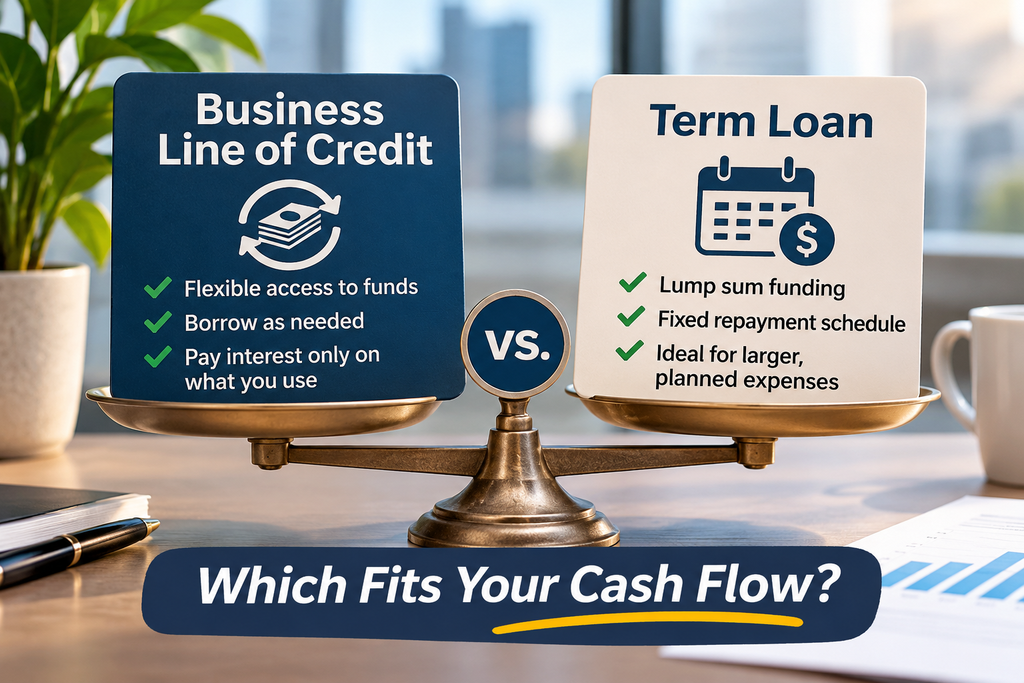
Choosing between a business line of credit vs term loan is really a decision about timing, flexibility and repayment risk. This guide explains the practical differences, with examples you can adapt to your own numbers.
Compare your working-capital needs and repayment capacity before applying. Funding is subject to review and approval.
Why the distinction matters
A line of credit and a term loan can both provide business capital, but they solve different timing problems. A term loan typically delivers a defined amount upfront, repaid over an agreed schedule. A business line of credit generally provides access to a credit limit, allowing eligible borrowers to draw funds when needed, subject to the agreement. Neither is automatically cheaper or easier to qualify for. The right choice depends on how much you need, when you need it, and how reliably your cash flow can support repayment.
Business line of credit: how it works
Suppose a distributor has a $75,000 approved line. It draws $18,000 for a temporary inventory shortfall and later repays $12,000. Depending on the agreement and continued eligibility, some repaid capacity may become available to borrow again. This flexibility can suit recurring gaps between supplier payments and customer receipts. Interest may apply only to drawn balances, but some lenders charge draw fees, maintenance fees, minimum charges, or require periodic renewals. Review whether the line is revolving, whether the lender can reduce or freeze it, and whether repayment is weekly, monthly, or triggered by a cleanup requirement.
Business term loan: how it works
A term loan provides a fixed amount, such as $60,000 to purchase machinery or renovate a storefront. The borrower follows the repayment terms in the agreement. A fixed-rate installment loan can make budgeting predictable; other loans have variable rates or nonstandard repayment structures. Compare the amount received after origination fees with the total amount to be repaid, and check prepayment penalties, collateral, guarantees, and late fees. A term loan is often a better conceptual fit for a known one-time purchase with a useful life that extends beyond the repayment period.
Side-by-side comparison
| Question | Line of credit | Term loan |
|---|---|---|
| Best-known use | Recurring short-term gaps | Defined upfront expense |
| Funding pattern | Draw as permitted up to a limit | Lump sum at funding |
| Repayment | Varies by balance and contract | Agreed repayment schedule |
| Cost traps | Draw, renewal and inactivity fees | Origination and prepayment fees |
| Access to more funds | May replenish after repayment | Usually requires a new application |
Worked example: a $40,000 seasonal cash gap
Imagine a retailer expects $40,000 in inventory purchases today and customer receipts over the following 90 days. If the need is genuinely temporary and repeats each season, a line may reduce the need to borrow the full amount year-round. For illustration only, drawing $40,000 at a hypothetical 15% annual simple interest rate for 90 days produces about $1,479 of interest ($40,000 × 0.15 × 90 ÷ 365), before fees and without compounding. That is not a lender quote. If the retailer instead borrows $40,000 on a 24-month installment term at a hypothetical 15% annual nominal rate with monthly amortization, the payment would be approximately $1,939 monthly and total interest approximately $6,547, before fees. These are different borrowing durations, so the numbers are not apples-to-apples: compare offers using the same cash needs, repayment dates, fees, and assumptions.
When a line of credit may fit
A line can make sense for businesses with uneven accounts receivable, recurring payroll timing gaps, seasonal inventory replenishment, or occasional urgent repairs. For a business with invoices due in 45 days but payroll due Friday, a line might bridge a well-documented timing difference. However, borrowing repeatedly to cover an operating loss is a warning sign, not a cash-management strategy. Before borrowing, inspect collections, margins, overdue receivables, and the likelihood that expected customer payments will actually arrive. Our guide to calculating the working capital gap can help size the need.
When a term loan may fit
A term loan can be appropriate when the amount and purpose are defined: buying equipment, fitting out a second location, or consolidating a planned investment into a known payment schedule. The repayment term should make economic sense relative to the asset or improvement being funded. If a machine lasts six years, a short repayment schedule that drains cash in six months may be unsuitable even if the headline interest rate looks attractive. For documentation considerations, see our equipment financing requirements guide.
How to compare two real offers
Start with a 13-week cash-flow forecast, then model at least three cases: expected receipts, receipts delayed by 30 days, and sales 20% below forecast. Record the net proceeds, all fees, rate structure, total repayment, repayment frequency, collateral, personal guarantee, default provisions, and early payoff rules. Ask whether the quoted rate is APR, simple interest, factor rate, or another measure. A factor rate should not be mistaken for APR. Compare the annualized cost where meaningful, but also compare the actual dollar cost and the size of payments in your lowest-cash weeks. A lower total borrowing cost can still be dangerous if payments arrive before collections.
Warning signs before signing
Be cautious when a provider will not give clear written repayment terms, encourages you to borrow more than needed, or asks you to ignore an existing lender covenant. Check whether daily or weekly debits could collide with payroll and taxes. Confirm whether the lender can take a lien on business assets or require a personal guarantee. Understand what happens if revenue falls. Avoid stacking multiple advances without a realistic repayment plan. If you are considering a merchant cash advance, read our comparison of merchant cash advances and revenue-based financing and our MCA requirements guide.
Documents to prepare
Lenders and funding providers may ask for recent business bank statements, revenue records, tax returns, existing debt details, time in business, ownership information, and a description of the funding purpose. Requirements differ significantly by product and provider. Keep a simple use-of-funds budget and a forecast showing where repayments will come from. If the business depends on a handful of large customers, model late payment by the largest customer rather than assuming every invoice pays on time.
Frequently asked questions
Is a business line of credit better than a loan?
Not universally. Lines can fit repeated short-term needs; loans can fit defined investments. Compare the complete contracts and repayment schedules.
Do I pay interest on an unused line?
Some arrangements charge interest only on drawn funds, but other fees may apply. Read the agreement.
Can I use a term loan for working capital?
Some products permit it. The key is whether the repayment schedule matches the expected cash generation.
Will either product require collateral?
It depends on the provider, product, financial profile, and contract. Unsecured products may still require personal guarantees.
Bottom line
Choose the financing structure around the timing of the expense and the source of repayment—not just the amount advertised. A short-lived, repeatable cash gap may point toward a line of credit; a clearly priced one-time investment may point toward a term loan. Review all costs and downside scenarios before committing. For more context on the timing of funding, see how fast business funding can arrive.
Compare your working-capital needs and repayment capacity before applying. Funding is subject to review and approval.
Disclaimer: Illustrative calculations are not offers or approval guarantees. Verify terms directly with the provider and consult qualified financial or legal advisers as appropriate.